Skip to content
AquaReefBasin

Gear

Test Kits

Every troubleshooting page on this site begins with a test result, because without one you are treating a guess. The two formats here answer slightly different questions: a liquid kit gives you a finer reading and takes longer, and a strip gives you a fast picture across several parameters at once. Both are accurate enough to act on when they are in date and used properly, and both are useless when they are not.

Core job: knowing the number instead of guessing it · 2 products listed

Read this first

  • Read every result against the white part of the card in daylight, never under a warm lamp and never through the tank glass.
  • Write the open date on every strip tube and reagent bottle the day you break the seal.
  • Check whether a kit reports the nitrate ion or nitrate-nitrogen before comparing its number to any published figure. The two scales differ by roughly a factor of four and a half.
  • A test kit tells you about water. It cannot tell you what is wrong with an animal, and no reading on it is a diagnosis.

What actually separates one from another

  • Which parameters it covers. Ammonia, nitrite, nitrate and pH are the four that appear in the reading panel on every fix page.
  • Number of tests, which is what actually determines how long a kit lasts rather than the size of the box.
  • How the reagents are handled. Liquid nitrate kits in particular depend on a genuinely vigorous shake of the second bottle, and under-shaking is the most common source of a falsely low reading.
  • Storage and dates. Strips in particular degrade quickly once the tube has been opened in a humid cupboard.

Side by side

Liquid kits holds one product, so there is nothing to compare it against. It is described in full below.

Strips holds one product, so there is nothing to compare it against. It is described in full below.

The products

Liquid kits

Reagent-and-tube kits. Finer resolution, more steps, and far more tests per box. The format to own if you own one.

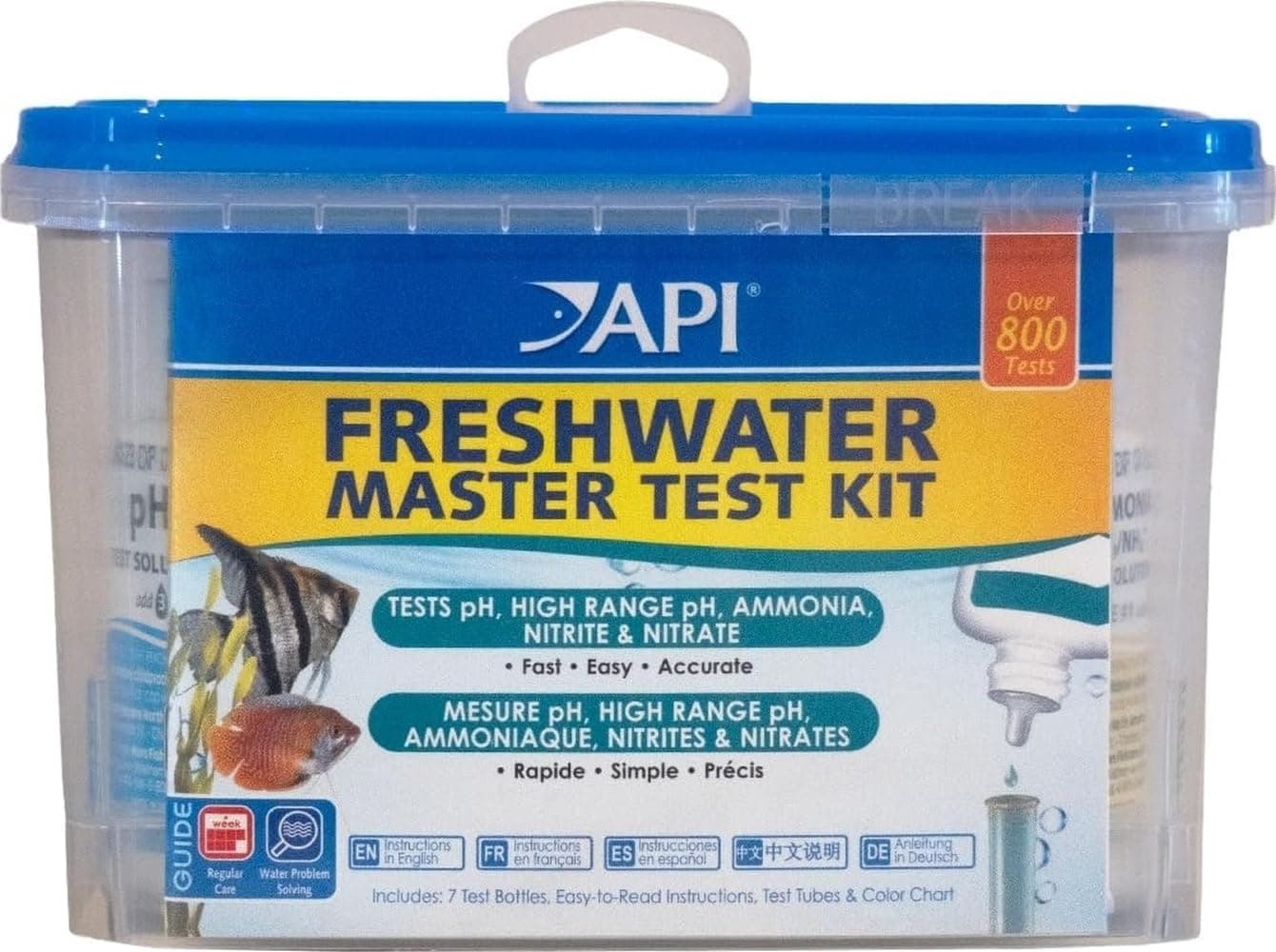
  • API Freshwater Master Test Kit

    Core pick

    API Freshwater Master Test Kit

    Up to 800 tests, four parameters

    A liquid reagent kit covering the four parameters that appear in the reading panel on every fix page, with up to 800 tests stated on the listing. It is the format to own if you own one. The nitrate test in particular rewards following the shaking instructions exactly.

    Why this badgeIt covers all four parameters in the reading panel — pH, ammonia, nitrite and nitrate — with up to 800 tests stated.

    The listing states this is a liquid kit covering pH, ammonia, nitrite and nitrate, with up to 800 tests.

    Good

    • Covers pH, ammonia, nitrite and nitrate — the four numbers every page here starts from.
    • The stated 800 tests is a very long working life for a home tank.
    • Liquid reagents give finer resolution than a printed strip pad.
    • Reagents in sealed bottles keep better than strips in an opened tube.

    Watch out

    • Each test takes several minutes, so a full panel is a fifteen-minute job.
    • The nitrate test fails silently if bottle 2 is not shaken hard enough, and it fails low.
    • Color matching against a card is subjective under poor lighting.

    Best forAnyone cycling a tank, and anyone who wants a weekly record they can trust.
    Check it on Amazon

Strips

Dip-and-read strips covering several parameters at once. Fast, convenient for a quick check, and sensitive to age and humidity.

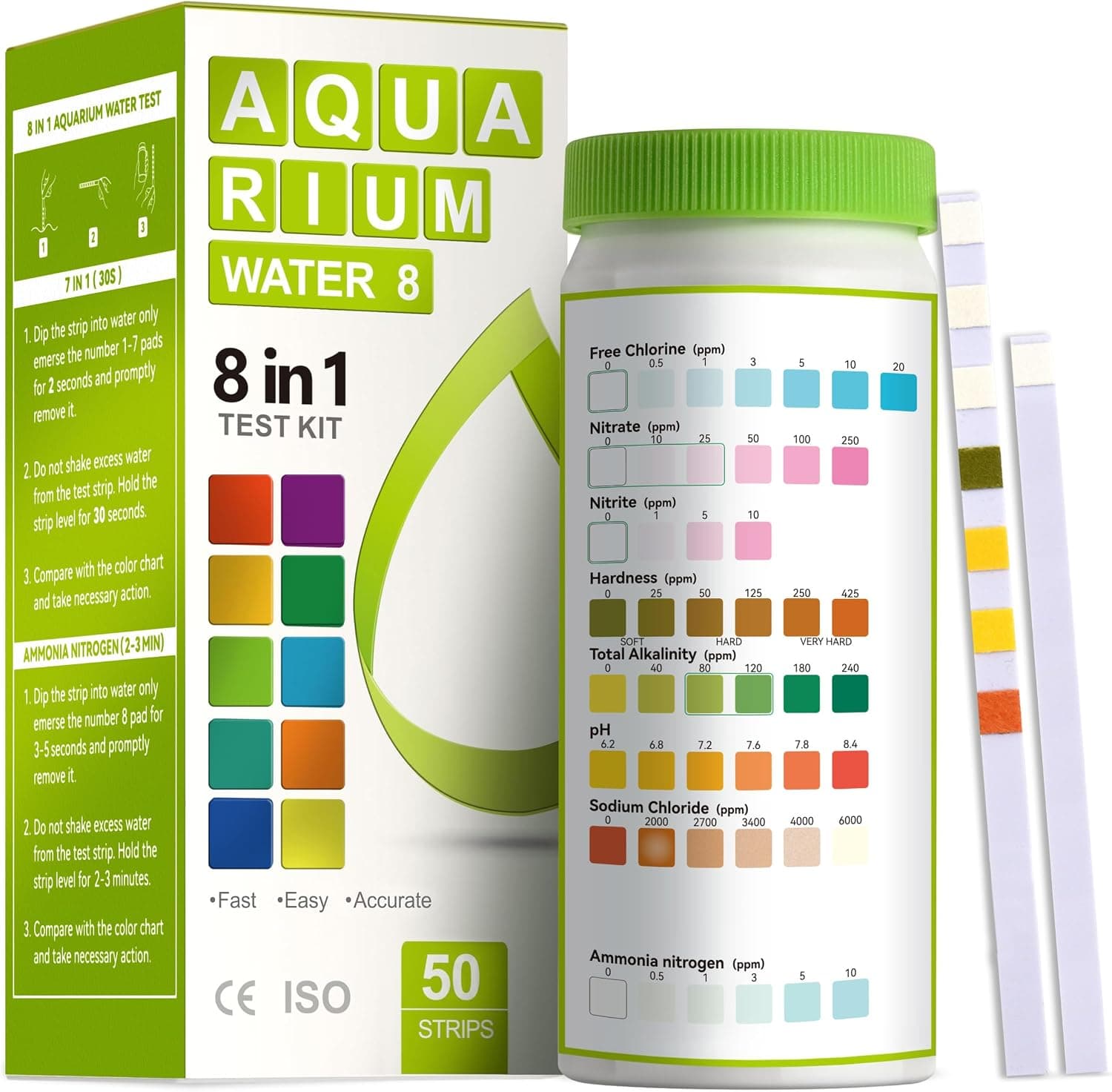
  • AAwipes 8-in-1 Aquarium Test Strips

    Fastest check

    AAwipes 8-in-1 Aquarium Test Strips

    8 parameters per strip

    Dip-and-read strips covering eight parameters at once, including several a standard four-test liquid kit does not: alkalinity, hardness and chlorine. That coverage is the real argument for keeping strips alongside a liquid kit rather than instead of one.

    Why this badgeEight parameters on one dip, including pH, ammonia, alkalinity, hardness and chlorine.

    The listing states these strips cover pH, ammonia, alkalinity, hardness and chlorine, in an 8-in-1 format.

    Good

    • Covers alkalinity, hardness and chlorine, which the four-parameter liquid kit does not.
    • A complete picture in under a minute, which makes frequent checking realistic.
    • Useful for testing tap water quickly before a water change.
    • No reagent handling, so nothing can be under-shaken.

    Watch out

    • Strips degrade once the tube is opened, especially in a humid cupboard.
    • Reading a printed pad against a printed chart is coarser than a liquid result.
    • The chlorine pad in particular changes fast and then fades, so it has to be read immediately.

    Best forQuick daily checks and tap water testing, alongside a liquid kit rather than instead of it.

    Check it on Amazon

Common questions

Are strips accurate enough to rely on?

A fresh strip used properly is accurate enough to act on, and it beats a liquid kit used carelessly. The trouble is that strips degrade quickly once the tube has been opened, so date the tube, keep it capped and dry, and replace it on schedule rather than when it runs out.

How often should I test?

Daily during a cycle, weekly once the tank is established, and immediately after any change to stocking, filtration or routine. The value is in the record over time rather than in any single reading.

My two kits disagree. Which do I believe?

Check dates first, then whether the reagents were shaken properly, then whether both were read in the same light on the same sample. Until you know, act on the more alarming reading — a water change is a safe response to either answer.

What should I test if I can only test one thing?

Ammonia, in a tank under two months old. Nitrate, in an established one. The first tells you whether the biological filter exists; the second tells you whether your maintenance is keeping up.

Where this comes up

Parameters this category touches